

“Our study… reveals the power of social, institutional forces to make good men engage in evil deeds”
Phillip Zimbardo
Stanley Milgram’s shocking obedience studies revealed that people will obey authority figures even if this entails acting against their own moral convictions. In the aftermath, Phillip Zimbardo set out to discover how people would behave if they were put into the position of authority with unimpeded power. Would they willingly use (or abuse) the power granted to them? In 1971, he carried out the now famous Stanford Prison experiment in which 24 middle-class American college students who had undergone tests to establish that they were mentally healthy.
On the flip of a coin, the students were randomly assigned the role of either “guard” or “prisoner”, and one Sunday morning soon afterwards, the prisoners were arrested at their homes, booked at a real police station and then transferred to the basement of Stanford University psychology department which had been converted into a mock prison with cells.
THE PRISON ENVIRONMENT
In order to make the experience as psychologically real as possible, prisoners were stripped, searched, deloused, and given uniforms and bedding upon their arrival. To heighten their sense of anonymity and dehumanisation, they were given numbers, and each had a chain bolted around one ankle to serve as a reminder of their lack of freedom.
The guards wore military-style uniforms and sunglasses (to make eye contact impossible), and carried keys, whistles, handcuffs and clubs. They were on duty 24 hours a day, and were given complete control over the prisoners, with permission to employ whatever tactics they saw fit to maintain order.
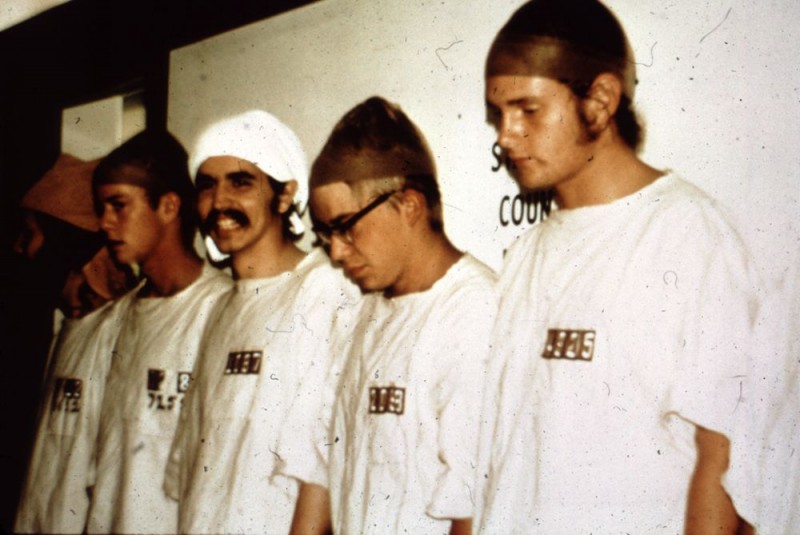
To the researchers’ amazement, the environment quickly become so threatening to the participants that the study had to be ended after only six days. Every guard became abusive and authoritarian; prisoners were being denied food or bedding, hooded, chained, and made to clean the toilet bowls with their hands. As the boredom increased, they used the prisoners as their playthings, making them take part in degrading games. After just 36 hours, one prisoner had to be released because of uncontrolled crying, fits of rage and severe depression. When other prisoners showed symptoms of acute distress, Zimbardo realised that the situation had become dangerous and ended the experiment.
Zimbardo’s experiment showed that good people can be induced into behaving in evil ways by immersion in “total situations” that have an apparently legitimising ideology and approved rules and roles. The implications are vast, as Zimbardo explains: “Any deed that any human being has ever done, however horrible, it is possible for any of us to do – under the right or wrong situational pressures”.
If you are curious to find out more, here are some links to videos which have footage and photos from the 1971 experiment, enjoy!
Also, an article from Inside Higher Ed in 2018 about recent revelations
 Science & Tea
One thought on “What happens when you put good people in an evil place?”